Xgon - Bidding and Back Office for General Contractors
An AI team drafts the bid; the price comes from the contractor's own numbers, never from a model
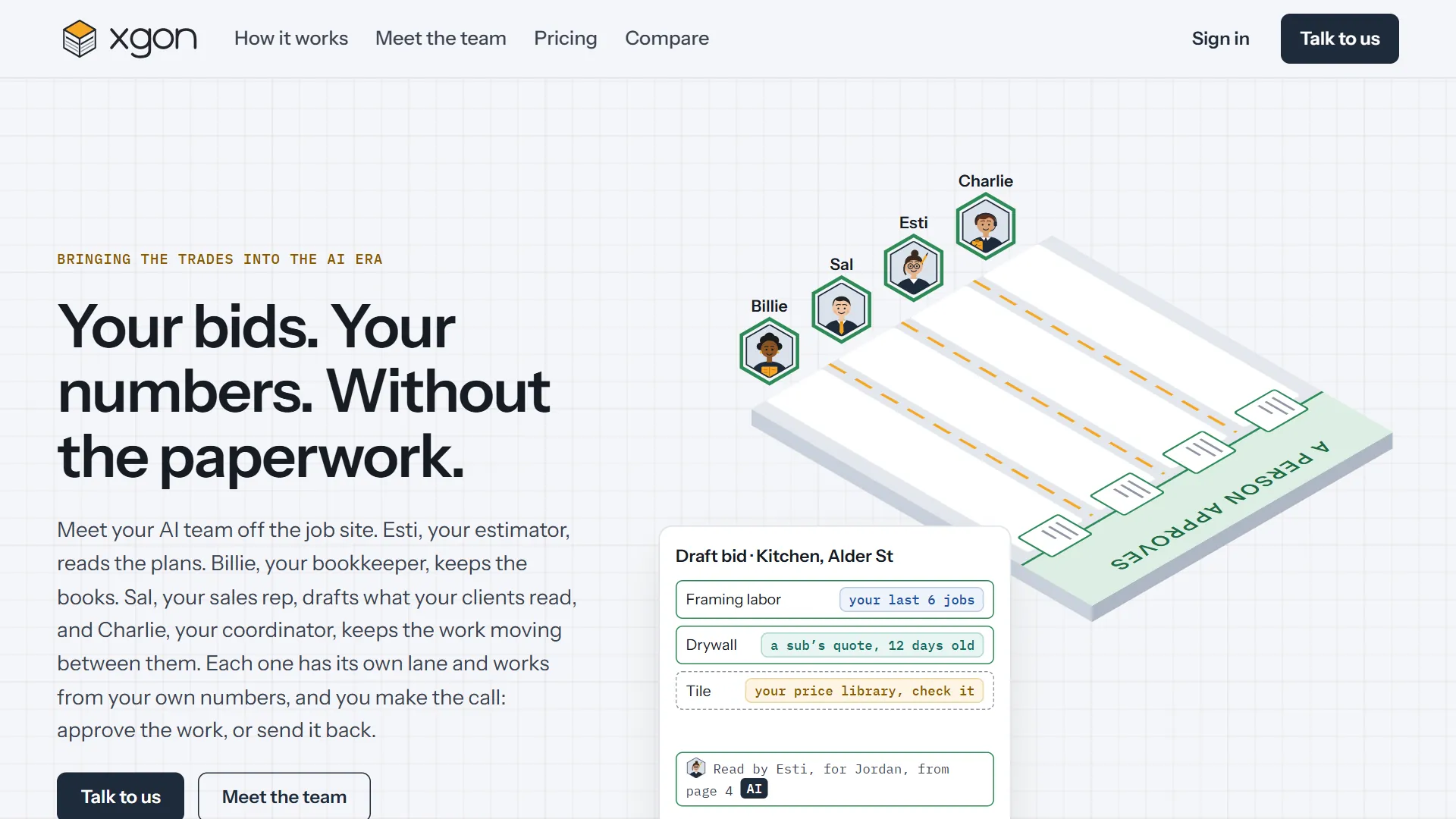
Top outcome
Live at xgon.ai in early access: every price comes from a deterministic engine fed with the contractor's own numbers, never from a model.
Stack
Next.js 15 · React 19 · TypeScript strict · pnpm monorepo
Overview
Every price from the engine
Totals, markups, margins and ranges run in a pure TypeScript engine. What the AI reads (scope items, quantities) goes into it as input. A model never produces a total.
Every number says where it came from
Each line names its source (the contractor's own jobs, past estimates, a sub's quote, the price library or an AI estimate) and how sure it is. The bid shows how much of it rests on the contractor's own numbers.
Past bids, read in
A past bid is filed, checked line by line beside the page it came from, and confirmed. Its prices become a pricing tier for the next bid. A bid that was lost is kept for its scope, with nothing priced.
Own labor in the job's cost
Once a week of hours is approved, what those hours cost at each person's rate reaches the job, beside what the books say.
A market watch that never changes a price
Open bids are watched against national producer prices for lumber, steel, gypsum and copper. A move of 3% or more since a line was priced flags that line. Nothing changes until the person does it.
A person decides
Scope is approved before anything is priced, and every AI draft waits for a named person in the company to approve it or send it back.
Xgon is the bidding and back office I built for small general contractors. It started from a bathroom bid: the owner priced it at $42K, ChatGPT said $48K and an employee said $25K. The owner was right because the number came from experience nobody else could see, and the chatbot was wrong with total confidence.
Read the full story
Xgon puts that experience where the whole company can use it. Past bids are read in and become a pricing tier, the crew's approved hours are costed into each job, and subs' quotes and a price library fill the rest. A deterministic engine turns those into a price with a likely range, and every line says where its number came from. AI assistants read the plans, draft the scope and chase the paperwork, each in its own lane, and a person approves or sends back every draft. A market watch flags open bids when lumber, steel, gypsum or copper prices move, and never changes a price on its own.
The marketing site went live at xgon.ai on 2026-10-26. The app is in early access, set up with each contractor on their own numbers.
How it works
- A bathroom job comes in to price.
- Three guesses disagree: the owner, a chatbot and an employee.
- Xgon reads the owner's past bids and crew labor costs, and watches material prices.
- The engine prices one likely range from those numbers. A person approves it.
The Problem
A general contractor bid a bathroom renovation at $42K. Asked to bid the same job, ChatGPT said $48K, too high. One of the company's own employees said $25K, too low. The real number lived in the owner's head: which past jobs compare, what the crew's labor really costs, when a supplier's price moved. None of it was written down where anyone else could use it, and the chatbot filled the gap with a confident number that had no source.
The Solution
I built Xgon, a bidding and back office for small general contractors. A team of AI assistants reads the plans, drafts the scope and chases the paperwork, each in its own lane, and a person in the company approves every draft or sends it back. The price never comes from a model. It comes from a deterministic pricing engine fed with the contractor's own numbers: past bids read in as a pricing tier, the crew's approved hours costed into each job, subs' quotes and a price library. Every line says where its number came from and how sure it is. A market watch flags open bids when material prices move, and the person decides what to do about it. A contractor can connect Claude or ChatGPT to ask about bids and jobs, but a connected assistant can never price a bid.
Impact
- 1Marketing site live at xgon.ai (2026-10-26); the app is in early access, set up with each contractor on their own numbers
- 2Deployed: past bids read in as a pricing tier (2026-10-08), crew hours in a job's cost (2026-10-01), a source and a likely range on every priced line (2026-10-14), and the market watch on lumber, steel, gypsum and copper (2026-10-26)
- 3One database with one organisation per contractor and row-level security between them, so one company never sees another's numbers
- 4Claude, ChatGPT or another assistant can connect to read what the contractor allows; it can never price a bid or move money (2026-10-16)
- 51,000+ commits on main (1,096 on 2026-10-26), shipped by Claude Code sessions against a numbered build plan
Key Decisions
- Designed and built end-to-end - product strategy, pricing model, multi-tenant data model, design system and the agent operating model, with Claude Code sessions shipping one numbered chip at a time
- AI never does arithmetic: every total, markup, margin and range is computed by the engine, and model output is only ever input to it
- Every priced line must carry a source and a confidence; a line without one cannot be saved
- Scope is approved before pricing: a bid moves draft, scope approved, priced, reviewed, sent, then won or lost
- A market move only signals. The watch flags lines and says by how much; the person adjusts, and the price library is never touched by it
- Built to be offered to many contractors from day one: one organisation per contractor, row-level security on every row, and nothing one company does written into the code
Lessons Learned
A chatbot is just as confident with no source as with one. The fix is not a better model; it is the contractor's own numbers in an engine that shows its work
A likely range says more than a single number, as long as it widens only for the lines the contractor is less sure of
A printed past bid is a sell price, not a cost: read as cost, the markup is added twice. The fix, merged 2026-10-26, asks once whether the client saw the prices with markup in them
Naming the AI assistants and giving each a lane made it obvious what each one may touch, for the contractor and for the code
Screens
1 / 3
More work like this
- Human Nature - Herbal Supplement StoreAn online store with subscriptions and live orders for a TCM supplement brand, running on Orchard
- Orchard - Multi-Tenant Commerce Control PlaneOne admin, many bespoke storefronts, full per-tenant isolation
- Toggled iQ Smart Building Platform1,000+ sites, 40,000+ devices, 30+ states