AI-Powered BACnet Datapoint Normalization
Days to hours: AI-driven site onboarding for smart buildings
Top outcome
Site onboarding cut from days to hours, with roughly 80% lower cloud token costs.
Stack
Ollama · Claude API · Python · SQLite
Overview
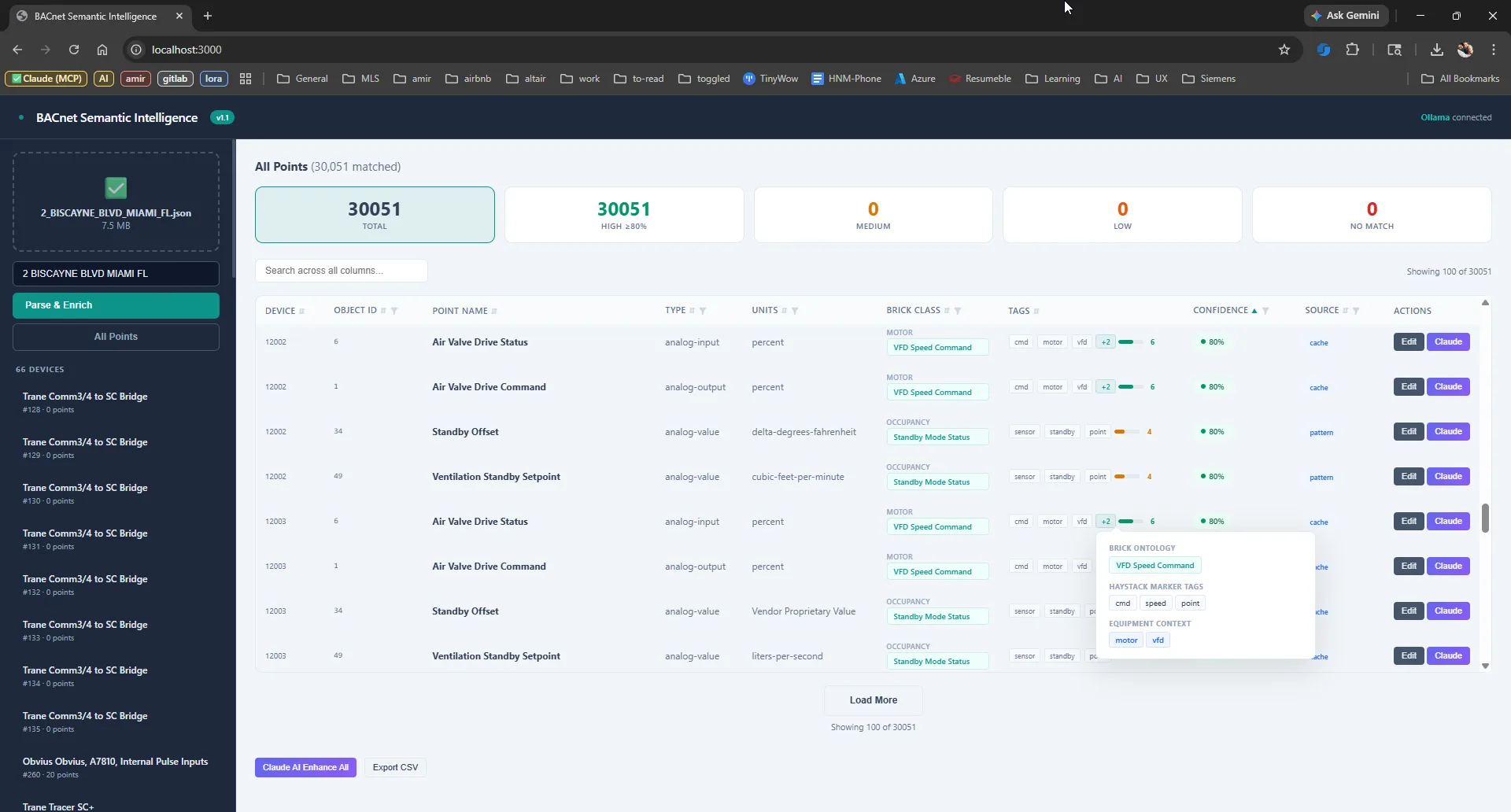
An AI-powered system that transforms chaotic BACnet datapoint naming into standardized formats across BRICK, Project Haystack, and W3C Web-of-Things (WoT) schemas. The engine uses primarily Ollama locally for the heavy lifting, supplemented by Claude API for complex edge cases, with domain-specific prompt templates to understand building semantics - equipment types, floor plans, zones, and measurement types - and automatically normalize thousands of datapoints per building. A human validation loop ensures production accuracy while reducing site onboarding from days to hours, unlocking downstream analytics and automation.
How it works
- Every building names its equipment points its own way.
- A local model proposes a standard name. Claude takes the hard cases.
- A person checks the result before it is used.
- Clean BRICK, Haystack and WoT names: onboarding in hours, not days.
The Problem
Commercial buildings have hundreds of heterogeneous BACnet devices with wildly varying naming conventions, making cross-building data analysis impossible.
The Solution
AI system that learns building semantics and auto-normalizes datapoint names to BRICK, Project Haystack, and W3C Web-of-Things (WoT) standards with a human validation loop.
Impact
- 1Site onboarding reduced from 3–5 days to 2–4 hours
- 2Enabled automated energy analytics across multi-building portfolios
- 3Unlocked downstream analytics, automation, and cross-site benchmarking by producing clean, standardized metadata
Key Decisions
- Built custom prompt templates for BACnet semantics (equipment type, floor, zone, measurement)
- Implemented local AI via Ollama for the heavy lifting, significantly reducing cost while reserving Claude API for complex edge cases
- Implemented human validation loop to catch edge cases (critical for production)
- Used context windows efficiently to process building metadata
Lessons Learned
Domain-specific AI requires deep understanding of the domain (BACnet conventions, building operations)
Production AI systems need human oversight; don't automate the human out of the loop
Accurate metadata (building schematics, equipment names) is foundational
Screens
1 / 4
More work like this
- Orchard - Multi-Tenant Commerce Control PlaneOne admin, many bespoke storefronts, full per-tenant isolation
- Toggled iQ Smart Building Platform1,000+ sites, 40,000+ devices, 30+ states
- Xgon - Bidding and Back Office for General ContractorsAn AI team drafts the bid; the price comes from the contractor's own numbers, never from a model